First prints vs reprints and variants: how to tell
Print lines, indicia, cover marks — how dealers confirm a first printing.
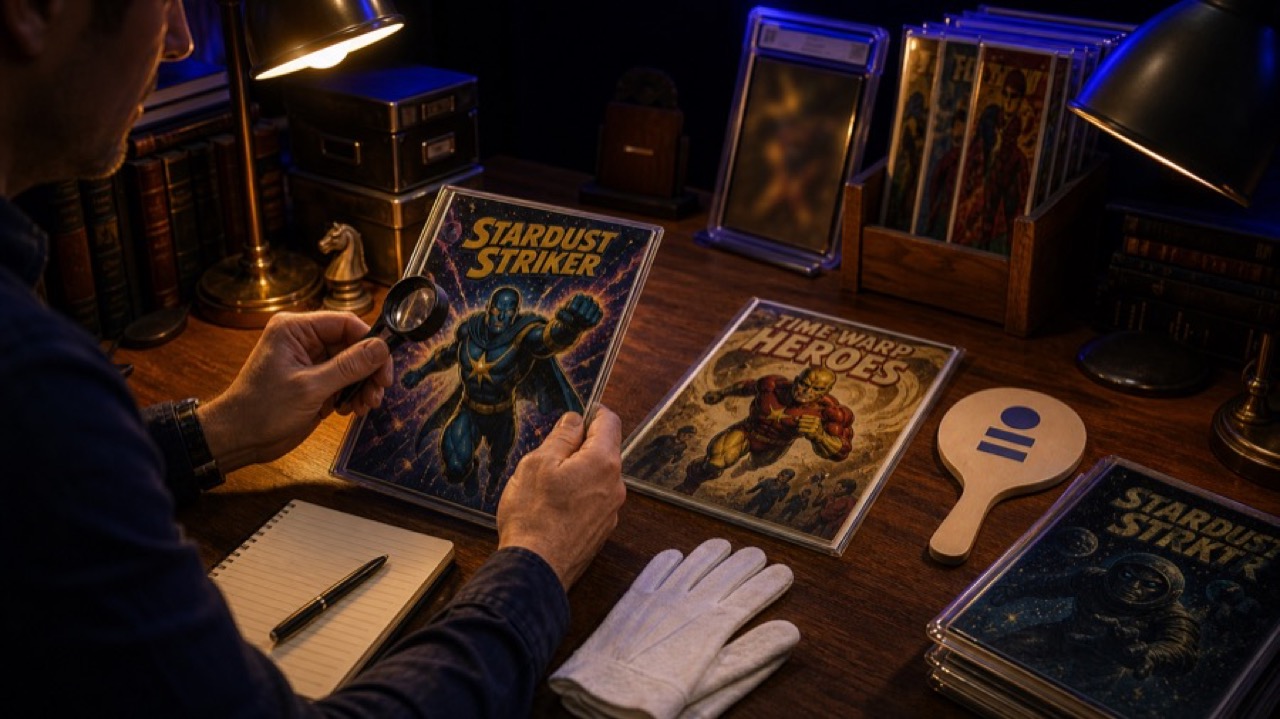
The same issue can exist as a first printing, several later printings, and a stack of variant covers — and the price gap between them can be enormous. A first printing of a sought-after issue can outvalue a later printing many times over. Learning to confirm a printing is one of the highest-leverage skills in collecting.
Where the printing hides
Most of the evidence lives inside the front pages, not on the cover:
- The indicia: The small block of fine print near the front — publisher, date, and often the printing details. This is the single most reliable place to confirm what you're holding.
- The printing line: Later printings frequently carry an explicit note ("second printing," a number sequence, or similar) that a first printing won't.
- Cover price and date: A mismatch between the cover price and the era of the issue is a tell that you're looking at a reprint.
First print vs. reprint
A reprint is a later run of an issue that originally sold out. It's legitimate and clearly marked — the goal isn't to fool anyone, but reprints are far more common and worth far less. Always check the indicia and printing line before assuming a book is a first.
Variant covers
A variant is the same issue published with an alternate cover. Variants range from common to genuinely scarce, and value depends on which variant it is and how many were produced. Tells include:
- A small variant code or note near the indicia or barcode area.
- A cover that differs from the standard while the interior issue is identical.
- Print-run or ratio markings indicating how limited the variant was.
How dealers confirm it
Experienced dealers don't trust the cover alone. They open to the indicia, read the printing line, cross-check the cover price against the era, and only then call a book a first printing. Do the same and you'll rarely overpay.
Using ComicLens
When you scan, ComicLens matches the likely issue and printing with a confidence indicator. If the match looks off — say a reprint matched as a first — fix it by hand so your reference range reflects the right book.
> Value figures are market reference range estimates only — not appraisals or financial advice.
Build a field-level evidence record
Keep publication, manufacture, and copyright observations in separate fields instead of one generic date line. The Library of Congress MARC 264 standard separates production, publication, distribution, manufacture, and copyright-notice functions; use that separation as a transcription discipline, not as proof of a physical copy's printing. Record `publication_statement`, `manufacture_statement`, `copyright_notice_date`, and `source_location` exactly as printed. A copyright-notice date must not silently replace a publication date, and an unstated field remains `UNKNOWN`.
Add a separate exact-transcription row for the issue's printed sequence: `designation_raw`, `designation_normalized`, `uncertain_characters`, and `evidence_image_ref`. Library of Congress MARC 362 guidance says sequential designators and dates are recorded as given on the item. A normalized lookup form can help search, but it must never overwrite the raw volume, issue, edition, number, punctuation, spacing, or date.
Keep an uncertainty and conflict log
When the cover, barcode, indicia, or a catalog record disagree, preserve every observation instead of choosing the most convenient result. Record `observed_on_item`, `external_match`, `conflict`, `resolution_status`, and `next_evidence_needed`. Do not invent a cause such as a replacement cover, facsimile, bound copy, or catalog error. The log documents a conflict; it does not explain one without evidence.
The Grand Comics Database public API includes an Action Comics number 1 record whose descriptor and variant name separately state `Second Printing`. This shows why issue number and printing descriptor belong in distinct fields. Use short, attributed metadata such as descriptor, issue number, publication date, indicia publisher, barcode, and related-record link only as comparison evidence. Do not reuse cover art or price fields, and never treat a database match as authentication of the physical copy.
Stop before naming a printing or variant when a required field is unreadable, printed fields conflict, or the compared record does not describe the copy in hand. ComicLens can supply a likely cover-based issue match and a confidence indicator that the user confirms or adjusts, but that likely match does not close an evidence conflict. Preserve `UNRESOLVED` and state what evidence is missing.
Use what makes a key issue for issue significance after identity is established, and consult fake or restored comic checks before relying on condition-sensitive observations. AI cover matching and metadata comparison are not professional authentication, certified grading, or appraisal, and no result guarantees value or resale.
Check the latest subscription options in the App Store.
FAQ
How do I tell a first printing from a reprint?
Check the indicia and any printing line inside the front pages — later printings are usually noted there. Cover price, logo placement, and variant cover marks are other tells.